
Following the June deadline for grant applications, our Board of Trustees recently convened to review and assess the latest round of submissions. While we received slightly fewer applications than in previous cycles, the quality and creativity of the proposals remained high, and the variety of ideas was both impressive and inspiring.
We are delighted to announce that we will be supporting the following projects:
COLOSS Honey Bee Association, 21st Conference in Copenhagen, Denmark.
Miss Eve Davies, University of Southampton, UK - The role of rapid crop and pollinator domestication on pollination efficiency and competition for floral resources.
Dr Andrea Drager, Indigenous Bagyeli community association, Cameroon - Morphology as a tool for elucidating stingless bee (Meliponini) diversity in Cameroon’s rainforest.
Dr Marcos Monasterolo, CONICET-Universidad Nacional de Catamarca - Connecting the Ecology of Stingless Bees to Native Forest Conservation in Argentina.
Dr Yahya Al Naggar, King Khalid University, Saudi Arabia - Enhancing Honey Bee Immunity: A Study on Heat-Inactivated Nosema Spores as a Potential Prophylactic Tool.
As always, we look forward to seeing how these projects develop in the months ahead and where possible, will be sharing updates on their progress.
Thank you to everyone who applied.
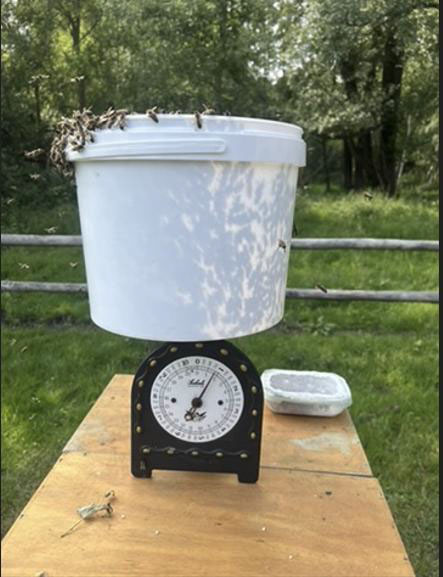
In the meantime, we are pleased to see that Dr Roessink at Wageningen University has been able to set-up his hives in preparation for his project titled CHESS-Clean Hives Enable Smelling Solutions. Dr Roessink said that the “…new colonies had to be started and young queens needed to settle in and build their colonies. Although sudden heat waves in the previous months caused some young queens to perform less well, at the moment all colonies in the test are established and the experiments are running properly”.
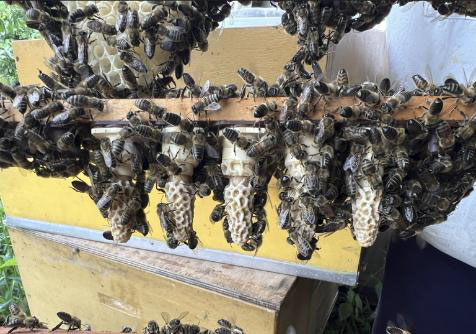
Images from Dr Roessink showing queen cells used for the project and the colonies of Nuc hives recieving a designated amount of worker bees.


