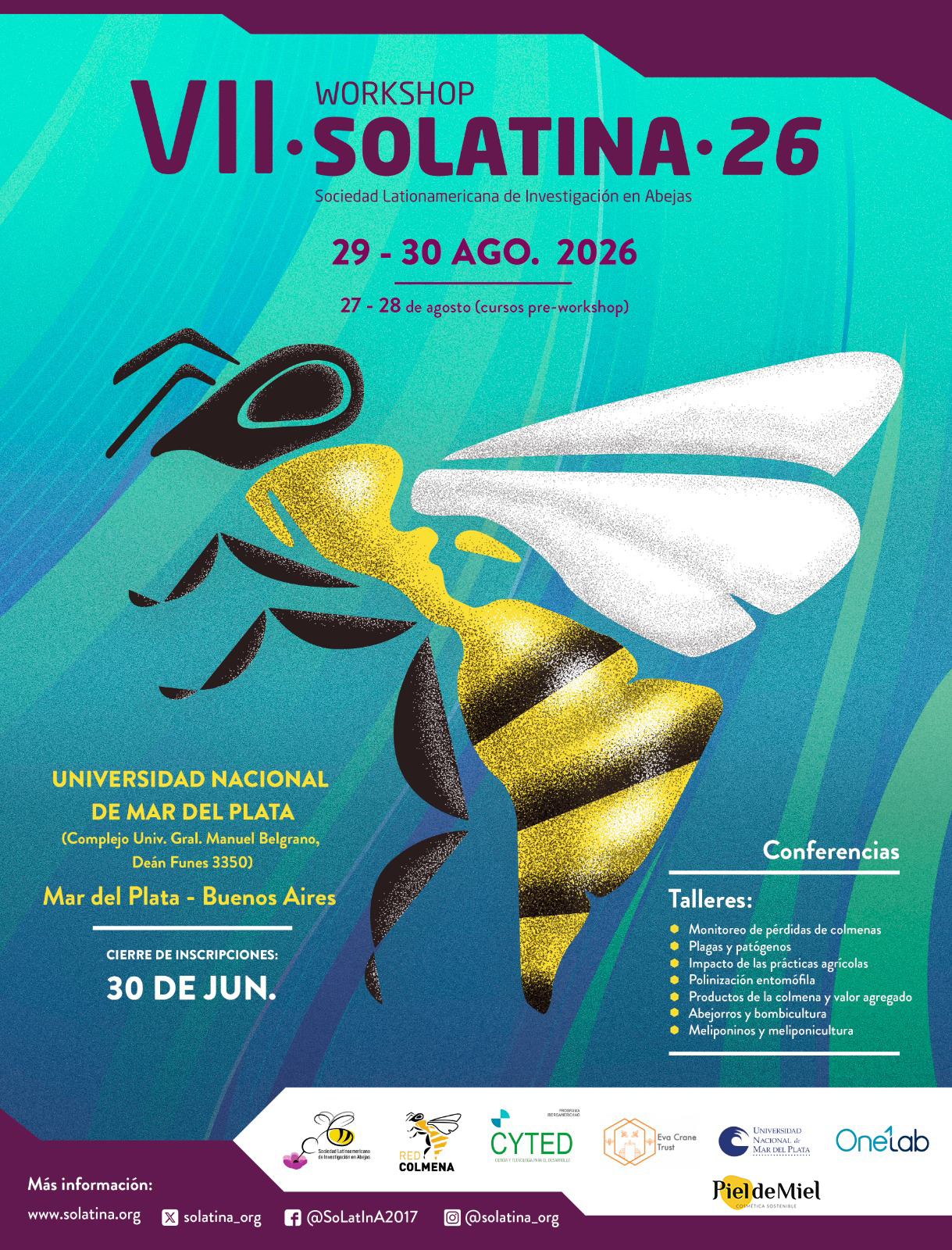

Photo: Malena Barabino.
Aims and objectives
SOLATINA, the Sociedad Latinoamericana de Investigación en Abejas (Latin American Society for Bee Research), was founded in 2016 with around 50 researchers from 8 Latin American countries. Ten years later, we are a consolidated network of more than 400 members from 20 countries, working in pathology, genetics, ecology, toxicology, microbiology, beekeeping and stingless beekeeping (meliponiculture).
We celebrated our tenth anniversary in August 2026 with a two-day workshop in Mar del Plata, held alongside the Federación Internacional Latinoamericana de Apicultura FILAPI 2026 conference. We had three main objectives: the first was to share the progress of our working groups since our last in-person meeting in December 2024 and to agree on their priorities for the coming years. The second was to bring together researchers from as many countries as possible, with particular attention to postgraduate students and early-career researchers from under-resourced regions. The third was to take advantage of the conference so that researchers could meet and exchange ideas with beekeepers during FILAPI 2026.
The meeting was organised by SOLATINA’s Executive Committee. The Eva Crane Trust and the COLMENA Network (CYTED) generously supported the event, which was declared of tourist and cultural interest by the Municipalidad de General Pueyrredon (City council), Mar del Plata, Buenos Aires province, Argentina. OneLab also supported this meeting by donating the lanyards for the name badges, pens, and notepads for all participants, and Piel de miel donated prizes for our best poster presentation contest.
Format
The workshop took place on the 29th and 30th of August 2026 at Facultad de Ciencias Exactas y Naturales, Universidad Nacional de Mar del Plata, Mar del Plata, Buenos Aires Province, Argentina. A total of 60 participants from 11 countries attended the event: Argentina, Bolivia, Brazil, Chile, Costa Rica, Ecuador, Honduras, Mexico, Paraguay, Peru and Uruguay. A third of the participants were postgraduate students or early-career researchers, and many of them were attending a SOLATINA meeting for the first time. The inclusion of a researcher from Paraguay at the workshop was a pleasant surprise. As our first member from that country, she helped us expand our network.
In the days before the workshop, two training courses were held, both based on data from Latin America: the third edition of a course on analysing data from colony losses, and the first edition of a new course about theoretical concepts and methodological tools for assessing the risk of pesticide exposure to bees. Each course had around 22 people signed up. The course participants had the chance to visit the Casa sobre el Arroyo, the house built over a stream between 1943 and 1945 by the architects Amancio Williams and Delfina Gálvez Bunge, now a national historic monument and a museum. It opens only on weekdays, so a small group could go, but those who did described it as a good break from the screen and the data.
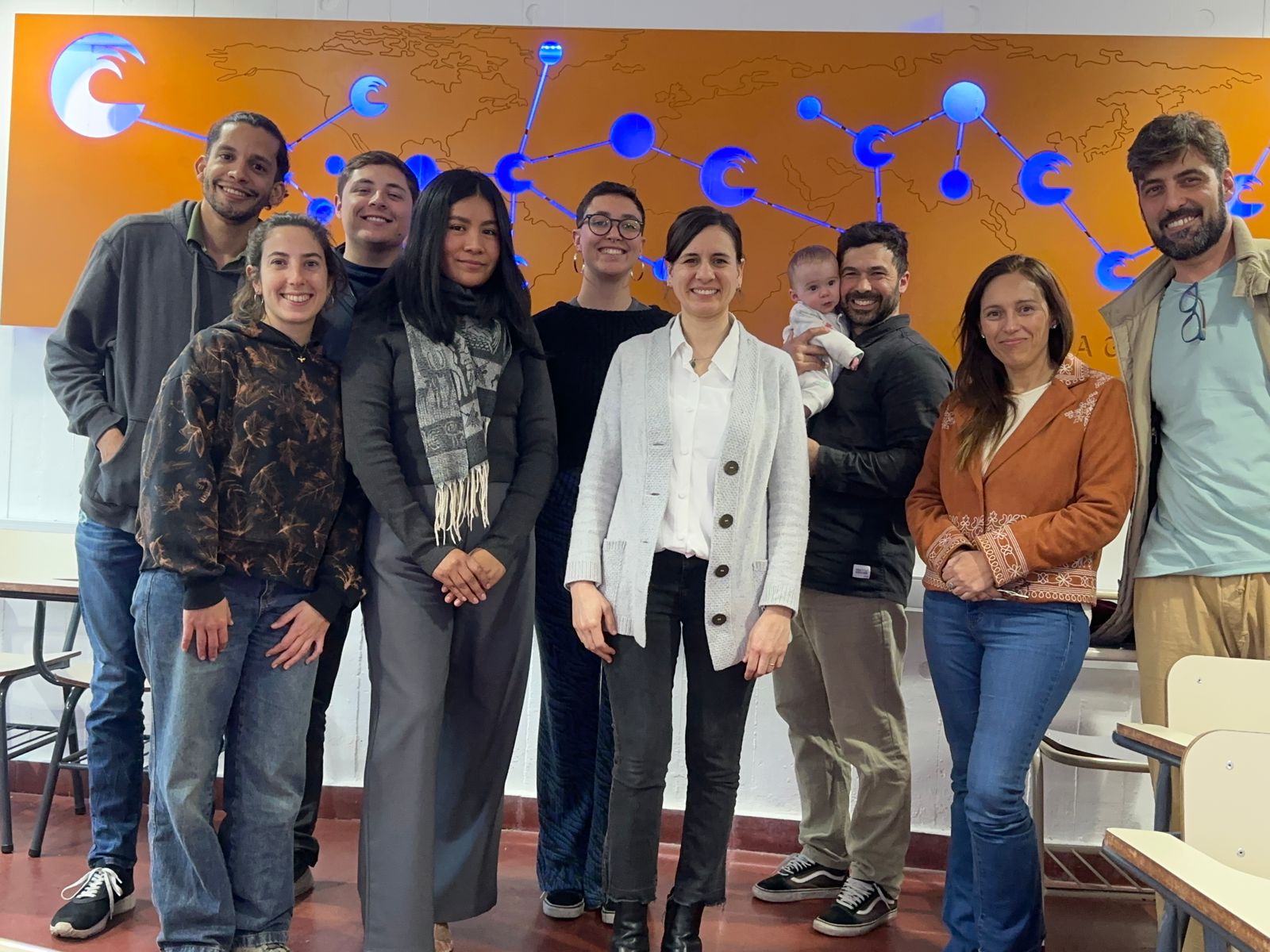
Participants of the course: analysing data from colony losses
The workshop itself was organised around six working groups, each of which met to review its work and plan the next period, with its own agenda.
The colony loss monitoring group was coordinated by K. Antúnez and recalled its objectives, methods and the information collected over the years, presented the published articles so far and those in progress, and discussed the main difficulties in collecting data. Its main agreement was to continue the survey on colony losses to complete ten years of data. To increase the number of responses per country, members agreed to strengthen the role of national coordinators, to seek funding for face-to-face visits to different areas, to produce outreach videos, and to give results back to beekeepers through talks and exchanges. Workshops, both in person and virtual, will continue as a way to train and work together on the databases.
The pests and pathogens group was coordinated by N. Bulacio-Cagnolo and P. Aldea, who presented two years of results, including published articles and courses. The group then held an intensive working session to set new guidelines and encourage the creation of new subgroups. Each one had to define its coordinators, objectives, short- and medium-term plans and expected results. Four subgroups were formally set up: Varroa resistance, emerging pests, honey bee genetics, and pests and pathogens of native bees.
The pollination group continued a piece of work already at an advanced stage, which characterises plant–pollinator networks across Latin America. Results and statistical analyses were presented and discussed in order to advance with the manuscript. The group also proposed a new subgroup, Landscapes and Pollination, which will use landscape ecology and spatial analysis tools to study how agricultural landscapes affect crop pollination.
The hive products group is working on two review manuscripts, one in honey adulteration and the other on propolis. The group agreed to prioritise original research over further review articles, and to coordinate multicentre studies to validate rapid, low-cost analytical methods for studying honey and propolis. The aim is to establish an accessible, standardised regional model for evaluating these products.
The stingless bee group presented its latest progress, including work shown at conferences and advances on a manuscript. Eight new members joined this meeting. They agreed to promote the colony loss survey in their countries and expressed interest in joining future projects. New research possibilities were also discussed.
The anthropogenic impact group looked at the widespread use of pesticides in Latin American agriculture and what it means for bees, human health and the environment. Through a discussion panel made up of women scientists who are experts on different thematic areas (Grecia de Groot, Marcela Dopchiz and Virginia Aparicio), the group addressed three key issues: scientific ethics, environmental pollution caused by pesticides, and a critical look at the hegemonic agricultural model, which is deeply dependent on external inputs such as pesticides and fertilisers. Their main conclusion was that as researchers we need to rethink scientific practices in the current context, in which pesticide mixtures are found in all environmental matrices, as well as in human and animal tissues, and the consequences of chronic exposure are unknown. They consider it’s essential to reorient research towards objectives that respond to socio-environmental problems; to work transdisciplinarily in order to have an overall view without over-partitioning the object of study; to train ourselves and work together with professionals to communicate scientific knowledge more efficiently to broad sectors of society beyond academia; and to ensure that our results contribute to the development of public policies that safeguard One Health.
On this occasion, we also wanted to support young researchers, so we held a best student poster contest. Four students won: Matilde Alarcón, Carmen Torres, Harold Pulido, and Selva Cora. Piel de Miel, a small business that makes skincare and personal hygiene items using ingredients from the hive, donated the prizes.
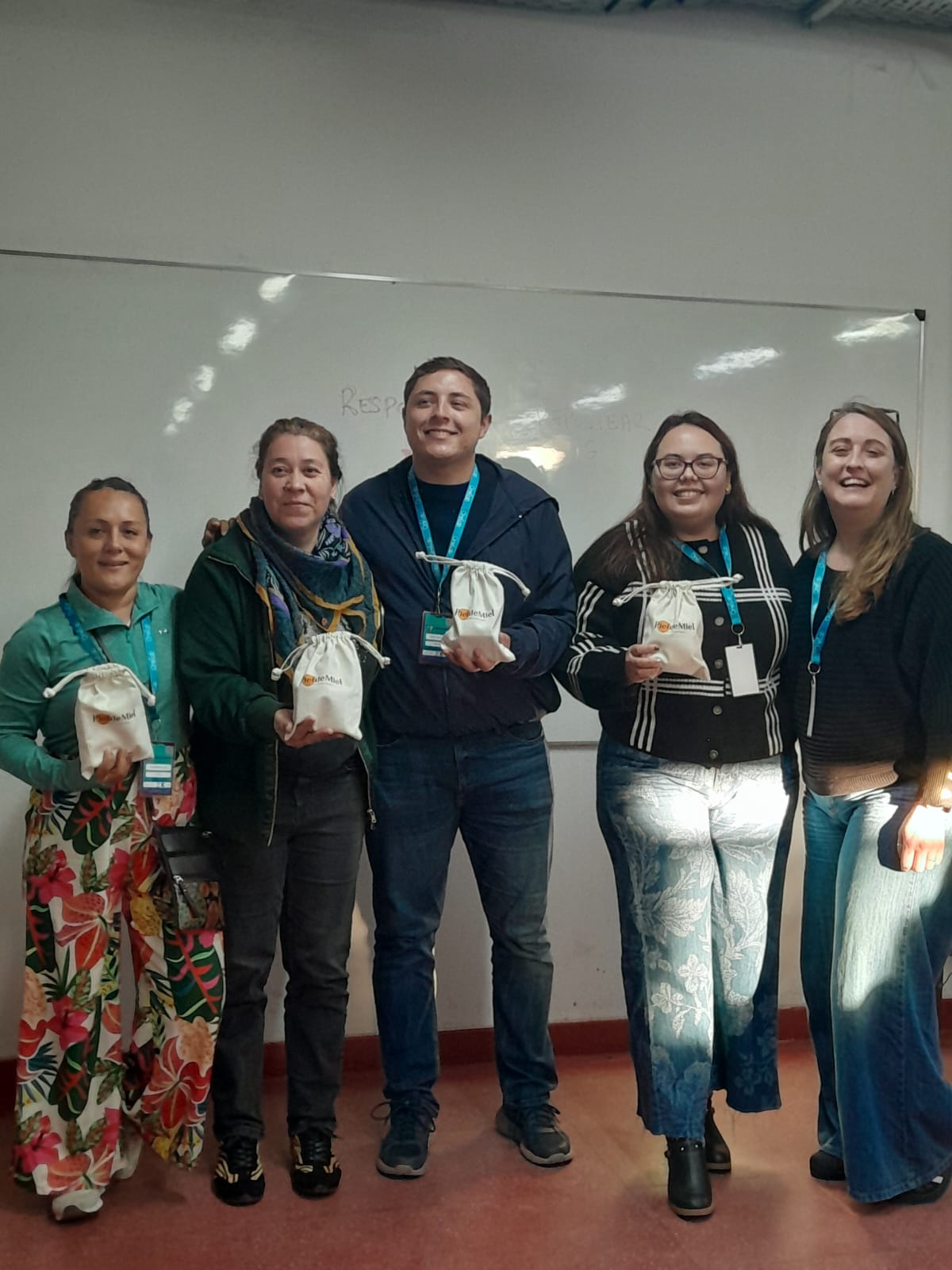
Winners of the best poster contest.
Holding the workshop next to the FILAPI 2026 conference allowed participants to combine both events in a single trip. Researchers who came to the workshop could meet beekeepers from across the continent, and others who had funding to attend the congress were able to join the workshop as well.
Conclusion
SOLATINA reached its tenth anniversary as a consolidated society, with working groups that have been producing research, courses and joint publications for years. The workshop did not start that work; it gave it a new stage. The groups reviewed what they have achieved, set new priorities and, in several cases, renewed their structures, with new subgroups, named coordinators and timetables.
The meeting also showed that the society is renewing itself. Many participants were attending for the first time, most of them postgraduate students and recent graduates, and Paraguay joined as a new country. That mix of experienced researchers and a new generation, working in the same rooms, is what will sustain the work of the society.
To learn more about SOLATINA and its working groups, visit our website: solatina.org
How we benefited from the Eva Crane Trust
The Eva Crane Trust awarded us £5,000. This allowed us to offer 34 small contributions towards travel costs for students and researchers, many of whom would not otherwise have been able to attend. Eleven countries were represented. The funding also helped us cover lunch and coffee breaks over the two days of the courses and the two days of the workshop, giving participants time and space to interact beyond the work of the groups.
The support of the Eva Crane Trust was acknowledged at the opening and closure of the workshop, on the SOLATINA website, so that every participant knew whose generosity had made the meeting possible.
Dr. Daniela Arredondo
Ref.: ECT_2026031166C
Completed 2026