

- Why the project was necessary
Healthy human diets are heavily dependent on pollinated crops, and the UK Government has recently reported that pollinators contribute annually £500m to the UK economy. However, serious environmental concerns have been raised regarding declines in pollinating insects, including pesticides and infectious diseases affecting honeybees. Therefore, alternatives that help pollinators overcome these threats are urgently needed. Microbes may indeed hold the key to sustainable apiculture solutions.
Microbes that live in symbiosis with the honeybees are crucial to enhancing protection against environmental challenges (https://doi.org/10.1038/s41579-023-00990-3); however their beneficial role is yet poorly understood. Besides, most of the studies have focused on the bacteria that populate the internal organs of the bee (e.g. gut), leaving out the fact that honeybees are social insects sharing many more microbes with all the members of the beehive. Very recently our research group has partly characterized the microbiome of the beehive (https://doi.org/10.1038/s41598-022-23287-6), a novel concept that encompass not only the bacteria naturally present in the bees, but also those that derive from plants (nectar and pollen), soil, water and other animals living in the same ecosystem as honeybees. By knowing the bacterial communities that define the microbiome of the beehive and how their presence and abundance correlate with health and disease, we will be able to identify the key beneficial bacteria (AKA probiotics) associated with protection against pesticides and bee infections. In other words, detecting bacteria in the beehive, rather than in individual bees, might be much more helpful to protect the honeybee colony as a whole. This very important scientific question has been addressed in this study.
- Aims and objectives
Very recently, our research group has sequenced DNA extracted from comb honey to capture a comprehensive snapshot of the microbiome of the hive (https://doi.org/10.1186/s40793-023-00460-6 ). Within the panel of identified bacteria, we have found that Lactic Acid Bacteria (LAB) are very abundant in antibiotic-free hives. LAB are the most popular bacteria used as probiotics worldwide and have been associated with bee health-promoting attributes such as the degradation of chemical residues ( https://doi.org/10.1007/s12602-025-10507-4) and antimicrobial activity against microbial pathogens (https://doi.org/10.1038/s42003-020-01259-8). Whether the presence or absence of LAB defines the beehive health is a very important question to explore and has therefore been addressed in this study.
The overall aim of this project was to investigate whether the presence of LAB associates with protection of the whole honeybee colony. To achieve this, the two following specific objectives were carried out:
(1) Determine the health status of the beehive to make correlations with its microbiome profile.
(2) Reveal the probiotic features of the bacteria whose abundance correlates with optimal beehive performance.
- Methodology
1. Measuring the beehive performance to determine the health status of the honeybee colony.
Scales and monitors were installed in the hives to measure several parameters such as the hive weight, internal temperature and the bee colony sound, therefore estimating the quantities of stored pollen and honey and the number of flying bees. All the data was collected on phones and computers via Bluetooth to be analysed and compared amongst hives. This resulted in an accurate and reliable description of the activity of the beehives over the spring-summer period.
2. Estimate correlations between the beehive performance and the presence and abundance of bacteria in honey.
Hives have been categorized as “moderately healthy”, “healthy” or “very healthy” based on the levels of activity (performance) measured with the scales and monitors. Simultaneously we have sequenced the DNA we extracted from the comb honey samples to identify the bacterial communities in each of the hives. The most abundant bacteria found in the hives categorized as “healthy” or “very healthy” will be then selected as potential bee health-promoting bacteria.
3. Reveal the functional features that make the selected bacteria probiotic.
The comb honey DNA was further sequenced using an advanced methodology to understand why some LAB are more abundant than others as this is likely to be due to their functionality such as specific probiotic characteristics like their capacity to produce antibacterial compounds, sugar/protein metabolism and pesticide tolerance.
Outcomes (Figure below)
- Sequencing analysis of the DNA extracted from hives that were managed in a more natural/organic way (e.g. no use of antibiotics) showed abundance of LAB.
- Predominance of LAB also associated with optimal hive performance (“healthy or very healthy” hives). Honeybees are more active in hives where less honey is accumulated and this correlates with LAB’ absence.
- LAB postulate as potential honeybee probiotics.
- Advanced DNA sequencing is expected to confirm LAB as promising bee-health promoting microbes based on their functional traits such as antimicrobial activity, digestion facilitation and pesticide degradation.
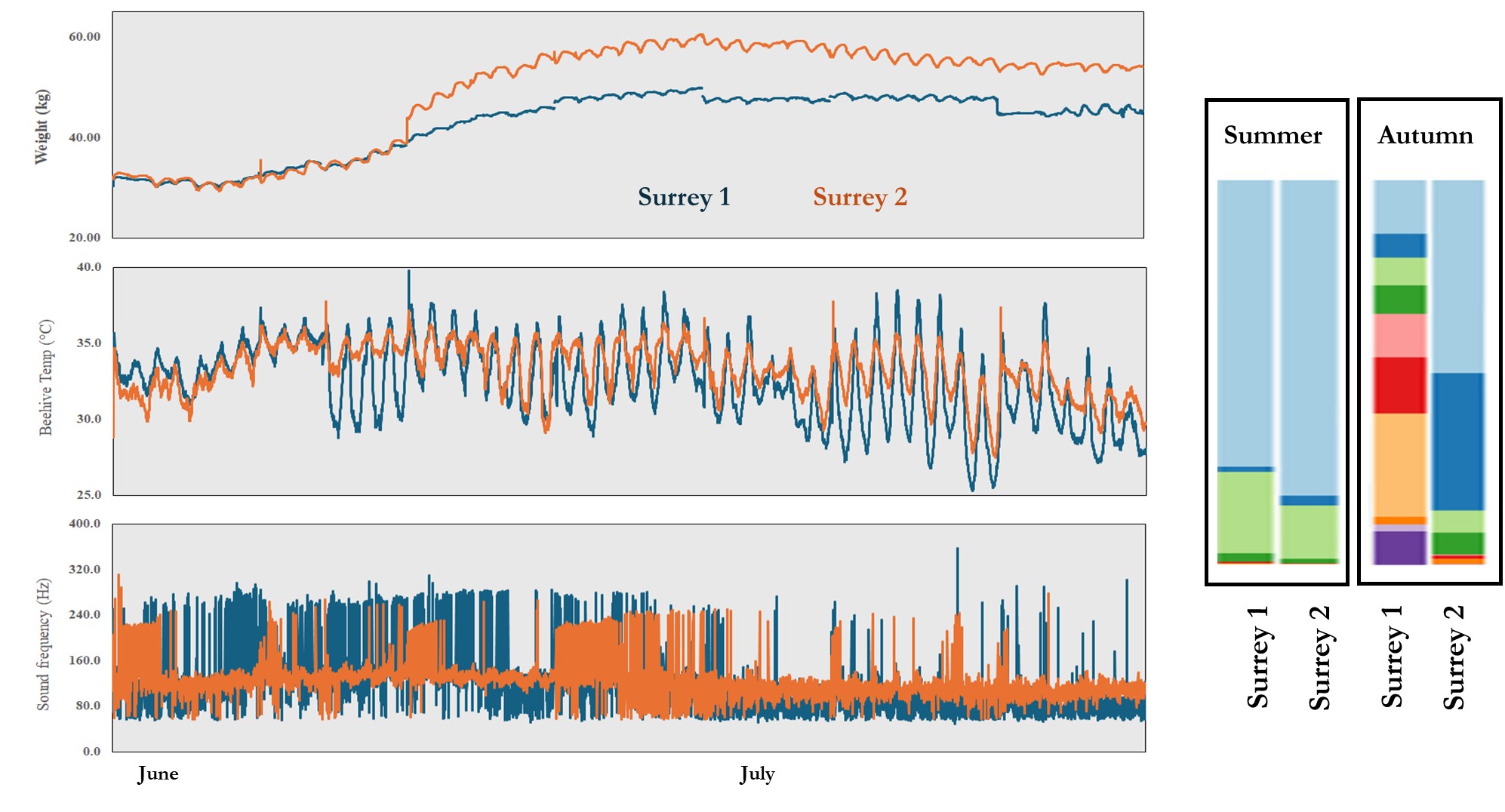
Amount of honey and pollen accumulated in two of the beehives located on the University of Surrey Campus over a 3-month period (measured in Kgs) and their corresponding internal temperature (°C) and sound frequency (Hz). On the right the relative abundance of the top bacteria present within each hive is illustrated with different colours and grouped by season of sample collection. Light blue represents the relative abundance of LAB.
- Conclusion
Our study has unveiled that the presence and abundance of LAB correlate with a healthy antibiotic-free hive environment. Specifically, we have identified certain species of LAB as potential honeybee probiotics following the sequencing and analysis of DNA extracted from hives where an optimal honeybee performance was recorded. LAB are known to possess key functional attributes that associate with bee-health promoting features. Although further work will be important to confirm these health-promoting properties our project has set up the foundation stone for the development and implementation of probiotic treatments as a sustainable apiculture alternative to reduce the occurrence of pesticides and honeybee pathogens that are currently threatening the delivery of pollination services.
- How you benefitted from ECT funding
Our experimental approach brings the exciting prospect of using honey from beehives as the central hub where potentially beneficial microbes occasionally accumulate, informing of the health of the honeybees. Pesticides and diseases affecting honeybees and other pollinators are a serious and continuous menace to beekeeping and the food production sector (https://doi.org/10.1371/journal.pone.0263273). In this respect, we have recently initiated a project to investigate how the DNA of honey can be exploited to forecast ‘early warning’ indicators of pathogen incidence in beehives based on the presence and abundance of LAB. Specifically, we are developing rapid diagnostic tests to detect LAB in honey. Once this new test is validated experimental interventions will be conducted using LAB strains that we have already isolated. In close cooperation with industrial partners, we will treat beehives with LAB-supplemented syrup, and the test will determine its abundance throughout the seasons and years to assess its impact on bee health. Samples from infected hives will also be tested to confirm whether the absence of LAB correlates with infections. The implementation of the proposed test would help beekeepers make rapid decisions and anticipate potential future diseases and therefore reducing and preventing the emergence and spread of bee pathogens.
Additionally, the results that this project has generated will be used as preliminary data to support research proposals that will be submitted for UKRI funding (e.g. BBSRC, NERC, Innovate UK…). The objective of our proposals will be to study the origin of the beehive microbiome and its influence on bee health. We will also pay attention to other funding opportunities such as the British Beekeeping Association awards, the CB Dennis Trust grant and PhD studentships like the recently renewed Doctoral Training Partnership (DTP) programs Wessex One Health and Food Biosystems.
Dr Jorge Gutierrez-Merino, University of Surrey, UK.
Ref.: ECT_20241262A
Completed 2025
Buzzing for change in Food Science and Technology: https://doi.org/10.1093/foodst/vwaf039
Instagram account - @uniofsurreybeekeeping (not strictly a PhD project as the initiative is led by a voluntary university group).