

Banner Image: Andrew Brown - MicroBEEome Spermatozoa
Project Background
Pollinator decline is pressing ecological challenges of our time. While much attention has rightly focused on habitat loss, pathogen pressure, and pesticide exposure, one dimension of bee health has remained understudied: male reproductive biology. Male bees (i.e. drones) are not just passive contributors to colony genetics, they are a key vehicle for genetic transfer during mating flights, and the quality of their reproductive output (e.g. quality spermatozoa) is fundamental to queen output (i.e. fecundity) and arguably, by extension, colony survival.
The gut microbiome of bees is now well established as a critical component of immune function, nutrition, and resilience. Interestingly, our institute’s in-house laboratory studies on drones from honey- and bumblebees reveal that these bacteria also appear to be in their reproductive fluid (e.g. seminal vesicles). However, whether this comes from sample-induced contamination or from a true a reproductive microbiome (i.e. bacteria residing within the seminal vesicles) was entirely unknown at the onset of this grant proposal. This is a significant knowledge gap. In mammals, seminal microbiota are increasingly recognised as influential in spermatozoa function and fertility outcomes [1]. If a parallel system exists in bees, it opens an entirely new lens through which to understand pollinator health, particularly in the context of chemical-induced impacts on bee reproductive health [2,3] via exposure of such chemicals.
Agrochemicals, such as neonicotinoids (e.g. Thiamethoxam) and herbicides (e.g. Glyphosate) are known to disrupt microbial communities [4,5]. Glyphosate, for example, which is primarily used a broad-spectrum herbicide, is also patented as an antibiotic (US Patent No. 7771736 B2). If male bees rely on a reproductive microbiome for optimal fertility, then chemical disruption of that microbiome could represent a previously unrecognised mechanism by which agrochemicals impair bee reproduction. Identifying and characterising this microbiome is therefore the essential first step toward understanding whether its disruption contributes to the reproductive consequences observed in pesticide-exposed bees, and ultimately, toward designing mitigation strategies.
Objectives
Here, we studied two key European pollinators, the western honeybee (Apis mellifera) and the buff-tailed bumblebee (Bombus terrestris). By combining both traditional beekeeping and bumblebee rearing with multiple scientific disciplines, we aimed at answer the following objectives: 1) Are seminal vesicles sterile at emergence?, 2) Does reproductive microbiome establish post-emergence?, 3) Are bacteria present in sexually mature males?, and 4) Do bacteria correlate with male fitness?
Methodology
To investigate whether a reproductive microbiome is present in honeybees (A. mellifera) and bumblebees (B. terrestris), colonies were maintained at our research facilities in Liebefeld (Switzerland) and male brood was monitored so that newly emerged drones could be identified and collected (Figure 1). In both instances, drones were reared under sterile (laboratory) or non-sterile (colony) conditions and sampled at several defined timepoints after emergence (0, 24, 120 hours (B. terrestris), and 0, 24, 96, and 240 hours (A. mellifera)), with timepoints 120- and 240- corresponding to sexual maturity of B. terrestris and A. mellifera respectively [6,7]. In the sterile conditions, the sucrose solution was autoclaved and the pollen was gamma radiated to limit bacterial acquisition from food. In the non-sterile methods, males were marked on their thorax and reintroduced to their source colonies.
On sampling days, age-controlled males were collected, their reproductive organs were isolated, and their seminal fluid was carefully collected. Subsequently, all fluids underwent microbiological analysis (Figure 2). For A. mellifera, two independent trials, totaling 120 drones, were carried out. Seminal fluid was cultured on agar plates, and isolated bacterial colonies were identified using standardized biochemistry techniques (Maldi-TOF : matrix assisted laser desorption – time of flight) [8]. For B. terrestris, three independent trials, totaling 89 drones, were carried out using the same aforementioned methods, in addition to gram staining and microscopic examination, and 16s rRNA sequencing [9].
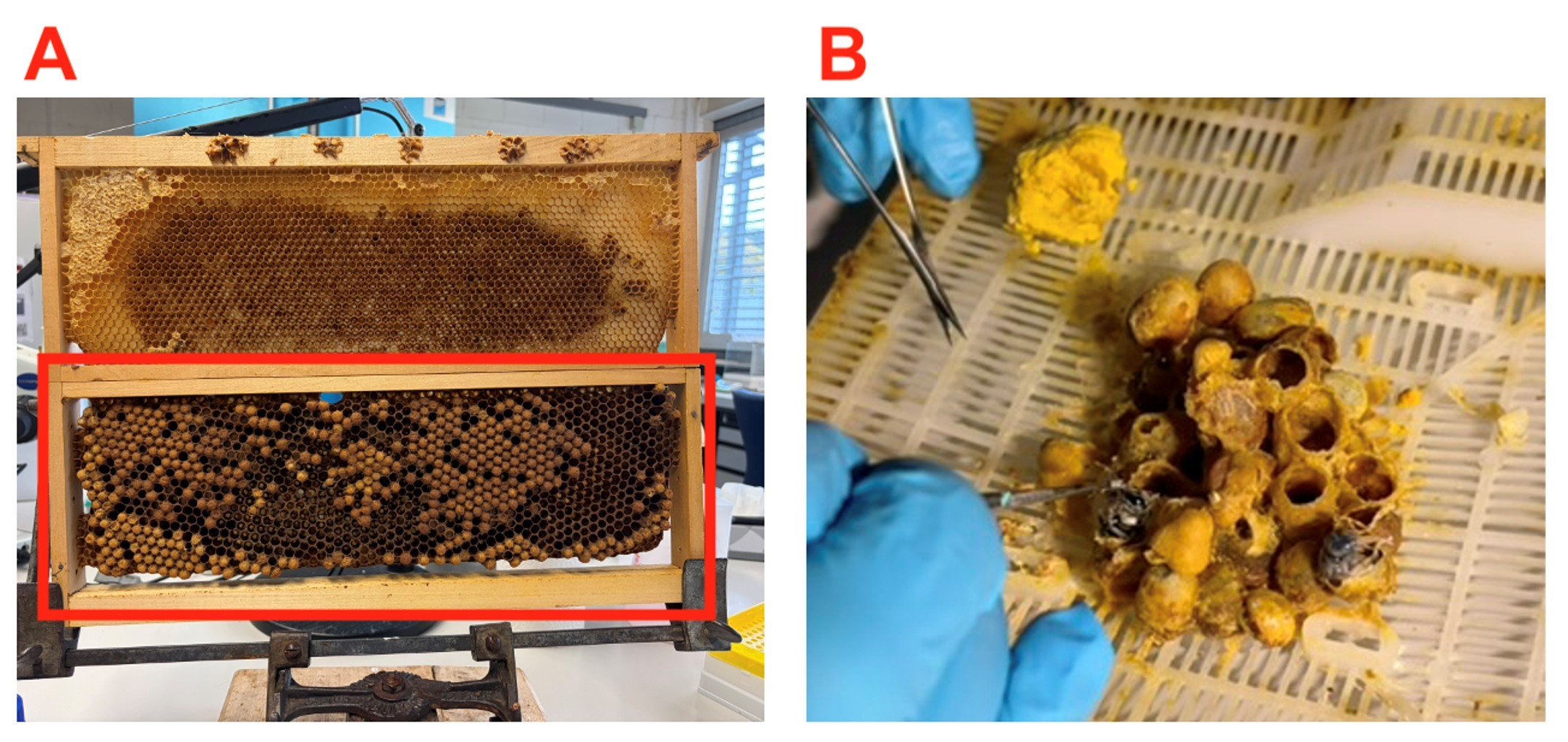
Figure 1: Identification and collection of male brood from the two study species, Apis mellifera and Bombus terrestris. Male brood of A. mellifera on the left side (A) highlighted by the red rectangle. Male brood of B. terrestris (B), with a male drone being removed using sterilized dissection equipment.
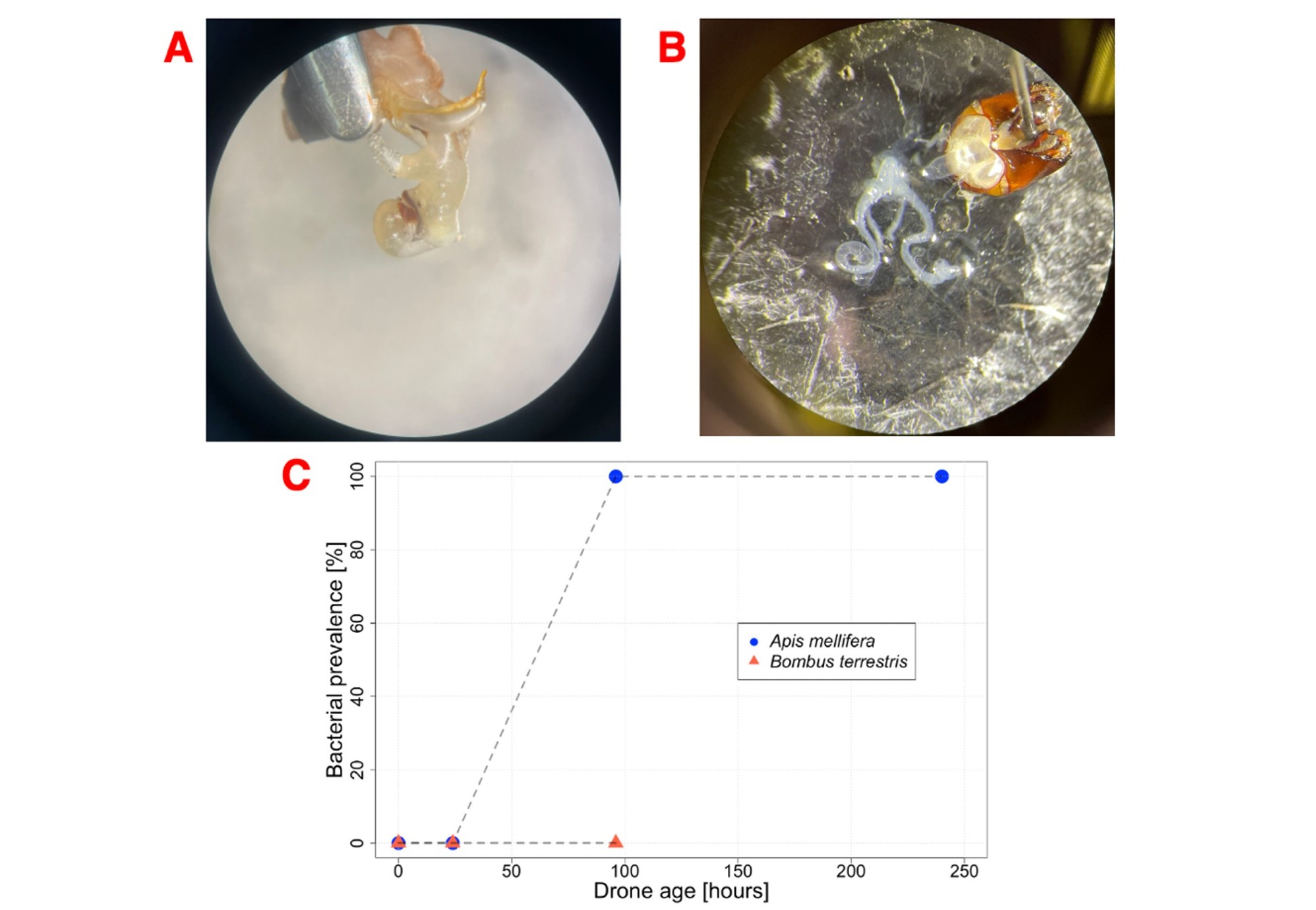
Figure 2:. Dissected male reproductive organs in the two study species, Apis mellifera (A) and Bombus terrestris (B). Bacterial prevalence in seminal fluid across age-controlled drones (C) showing no bacterial detection in B. terrestris and bacterial presence in all sexually mature A. mellifera samples.
Outcomes
The MicroBEEome project revealed clear ecological differences between the reproductive biology of the two bee species studied. No bacteria were detected in any B. terrestris drones, indicating that the male reproductive tract of this species appears to truly be sterile. In contrast, all sexually mature A. mellifera samples tested positive for bacteria, supporting the presence of a reproductive microbiome in honeybee drones [10].
An unexpected and novel finding was that the bacteria detected in honeybee drones appear to be transferred through interactions with other bees (i.e. workers feeding drones), rather than acquired directly from the surrounding environment. This suggests that the reproductive microbiome may be socially mediated. While biologically important, this discovery also revealed a methodological challenge that must be overcome before the relationship between these bacteria and male fertility can be tested conclusively.
Conclusions
This project demonstrated that male reproductive microbiology differs substantially between the two studied bee species, A. mellifera and B. terrestris, hinting that a reproductive microbiota is likely not a universal feature of pollinator biology. The apparent sterility of the bumblebee reproductive tract provides a comparatively “clean” system for future studies of male fertility. In honeybees, the presence of bacteria appears to be closely linked to normal colony care (i.e. trophallactic feeding of drones), suggesting that the reproductive microbiome is likely part of a broader social process rather than an isolated feature of the male reproductive system. This unexpected complexity changes how future experiments must be designed, particularly where researchers aim to separate microbial effects from worker–drone interactions. Future studies should aim to develop improved rearing approaches that minimize microbial transfer, for instance, by maintaining larger groups of drones without workers or by using worker bees with substantially reduced microbiota. These strategies would hopefully allow the drone reproductive system to be examined more independently.
How we benefitted from Eva Crane Trust (ECT) funding
Funding from the ECT provided essential support for both the past experimental and future dissemination stages of the project. It enabled the purchase of key laboratory materials (e.g. syringes, bacterial culture media, etc) as well as administrative costs associated with international collaboration. The remaining funds are planned for future publication, conference, and travel costs, helping ensure that the findings are shared with the wider scientific and pollinator research communities.
Dr Andrew Brown
University of Bern, Institute of Bee Health Switzerland
Ref.: ECT_202509820A
Completed: 2026
References
- Youssef R, Aimone-Vianna C, Schvoerer E, Lozniewski A, Fattet AJ. Sperm microbiota and its potential impact on male fertility: a systematic review. Reproductive Medicine. 2026;7(1):8. doi:10.3390/reprodmed7010008.
- Brown AF, Giovenazzo P, Paillard M, Rousseau A, Strobl V, Van Oystaeyen A, et al. Common herbicide impairs fertility but not survival in bumblebees, Bombus impatiens. Scientific Reports. 2025;15(1):42276. doi:10.1038/s41598-025-22720-w.
- Straub L, Minnameyer A, Camenzind D, Kalbermatten I, Tosi S, Van Oystaeyen A, et al. Thiamethoxam as an inadvertent anti-aphrodisiac in male bees. Toxicology Reports. 2022;9. doi:10.1016/j.toxrep.2021.12.003
- Rouzé R, Moné A, Delbac F, Belzunces L, Blot N. The honeybee gut microbiota is altered after chronic exposure to different families of insecticides and infection by Nosema ceranae. Microbes and Environments. 2019;34(3):226–33. doi:10.1264/jsme2.ME18169.
- Motta EVS, Raymann K, Moran NA. Glyphosate perturbs the gut microbiota of honey bees. Proceedings of the National Academy of Sciences of the United States of America. 2018;115(41):10305–10. doi:10.1073/pnas.1803880115.
- Winston ML. The biology of the honey bee. Cambridge (MA): Harvard University Press; 1991.
- Baer B. Bumblebees as model organisms to study male sexual selection in social insects. Behavioral Ecology and Sociobiology. 2003;54(6):521–33.
- Brown A, Rodriguez V, Pfister J, Perreten V, Neumann P, Retschnig G. The dose makes the poison: feeding of antibiotic-treated winter honey bees, Apis mellifera, with probiotics and B-vitamins. Apidologie. 2022;53(2):19. doi:10.1007/s13592-022-00927-4.
- Watrous KM, Larson MJ, Nelson AS, Hammer TJ. A culture collection of gut bacteria from wild bumble bees (Bombus impatiens). Microbiology Resource Announcements. 2026;15:e00791-25. doi:10.1128/mra.00791-25.
- Yániz J, Toquet M, Santolaria P, Silvestre MA, Toledo-Perona R, Gómez-Martín Á. Microbiota analysis of ejaculated honey bee drone semen and the effect of semen collection method on bacterial loads. Insects. 2024;15(6):377. doi:10.3390/insects15060377.