

Banner Image: JessEPion
Research case
Protecting honey bees requires more than finding a treatment that kills their pests and pathogens. Any control method must also be selective enough to protect the colony itself. This is especially challenging because a hive is a tightly connected biological system: brood, adult workers, wax, honey and pollen all occupy the same space, so an intervention directed at one organism can unintentionally affect many others, and is particularly problematic when targeted pests are also insects or other arthropods. Small hive beetles, wax moths and Varroa mites each exploit this environment in different ways, yet the options available to manage them remain limited by concerns about residues, resistance and non-target effects (Rosenkranz et al., 2010; Kwadha et al., 2017; Roth et al., 2022). Entomopathogenic nematodes offer considerable promise because they are naturally occurring insect pathogens, can be highly effective against susceptible pest stages and do not leave conventional pesticide residues (Dillman & Sternberg, 2012; Shapiro-Ilan et al., 2017; Tarasco et al., 2023). However, their broad infective capacity also means that they cannot be assumed to be safe for honey bees and other pollinators simply because they are biological control agents (Katlav et al., 2026). The key scientific and practical question is therefore not only whether EPNs can kill hive pests, but whether they can be deployed at the correct life stage, dose and location while avoiding harmful exposure of honey bee brood and workers.
This project is important because it addresses that question through an integrated sequence of experiments. It combines large-scale EPN screening, direct assessment of honey bee susceptibility, semi-field targeting of the soil-dwelling stage of small hive beetle, and comparative RNA sequencing across pest and honey bee hosts. This approach links efficacy, safety and mechanism. It shows which EPNs are most active, where they can be applied most strategically, how honey bees may be affected, and why different hosts vary in susceptibility. The study therefore provides a stronger scientific foundation for developing EPN-based pest management that is not only effective, but also targeted, evidence-based and compatible with honey bee health.
Aims and objectives:
- Determine whether direct EPN exposure affects honey bee larvae, pupae and adult workers under controlled and hive-like conditions.
- Evaluate whether the soil-dwelling stage of small hive beetle can be targeted away from the colony using selected EPNs.
- Compare the early and developing molecular responses of small hive beetle, greater wax moth and honey bee larvae to two biologically distinct EPN species.
- Create an evidence-based framework in which pest efficacy, application context and honey bee safety are assessed together.
To address these objectives, the study comprised three interconnected stages:
Stage 1: Defining European honey bee safety boundary
This first stage has been published in the Journal of Invertebrate Pathology (Katlav et al., 2026; Figure 1). This study was a large, multi-stage assessment that progressively moved from highly controlled laboratory exposure to brood-comb and subcolony/in-hive conditions. Final-instar honey bee larvae were tested against 32 Australian isolates representing five EPN species at 25 °C, and selected isolates were also assessed at 33 °C to approximate the brood-nest environment. Newly emerged adult workers were tested against 12 selected EPN isolates. Additional experiments examined whether Varroa parasitisation changed larval susceptibility, whether EPNs could infect uncapped larvae and capped pupae within wax cells, how direct application affected experimental subcolonies, and whether honey reduced nematode survival.
Honey bee larvae were susceptible to all isolates tested, although virulence varied greatly among species and isolates. At 25 °C, median lethal concentrations ranged from approximately 0.66 to 6.8 infective juveniles per square centimetre. Virulence was generally reduced at 33 °C, but every tested isolate remained pathogenic. Newly emerged adult workers were also susceptible, with median lethal concentrations of approximately 1.8 to 10 infective juveniles per square centimetre. Heterorhabditis indica Hi.HRN2 was consistently among the most virulent isolates.
The study also showed that Varroa parasitisation can increase vulnerability to some EPNs. The highly virulent Hi.HRN2 caused high mortality regardless of Varroa parasitisation status, whereas larvae parasitised by Varroa were more susceptible to the less virulent Steinernema feltiae Sf.CPBR2 (Figure 2). This indicates that tissue injury or immune disruption caused by one stressor can alter the outcome of exposure to another.
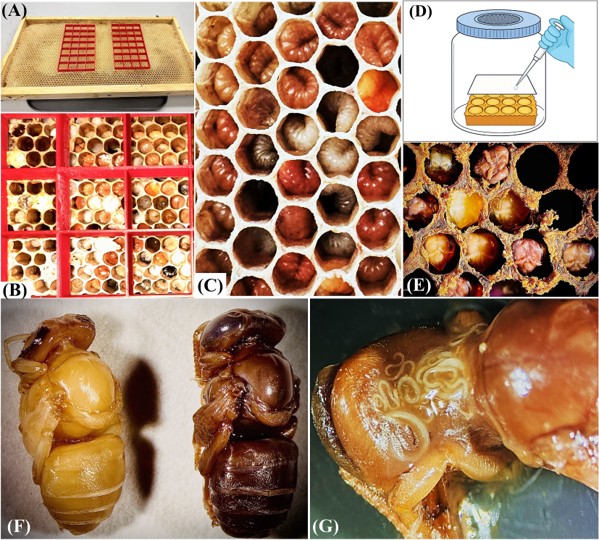
Figure 1. Experimental assessment of honey bee brood susceptibility to Heterorhabditis indica Hi.HRN2. Panels A-C show treatment of uncapped last-instar larvae within wax cells and the characteristic discolouration of infected brood. Panels D-G show the capped-brood assay, infected pupae and nematodes confirmed within dissected brood. The experiments moved beyond Petri-dish exposure to determine whether infection could occur in the physical structure of a brood comb. Source: Katlav et al. (2026), Journal of Invertebrate Pathology 215, 108524.
Under brood-comb conditions, direct treatment of uncapped larvae with Hi.HRN2 produced approximately 70% mortality, compared with about 18% in controls. Capped brood was partly protected, but not completely: pupal mortality was approximately 17% at 100 infective juveniles per comb segment and 33% at 1,000 infective juveniles, compared with less than 5% in controls. In experimental subcolonies, direct brood-frame treatment increased mortality across larvae, pupae and adult. Honey reduced EPN survival in a concentration-dependent manner, and hive structure and worker hygienic behaviour appeared to moderate exposure, but neither eliminated the risk created by direct application.
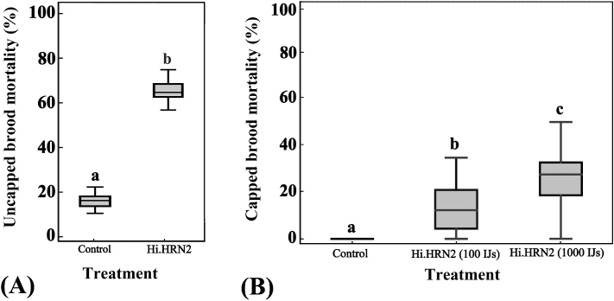
Figure 2. Mortality of honey bee brood after direct exposure to H. indica Hi.HRN2 under in situ comb conditions. (A) Uncapped larval brood treated with 10 infective juveniles per cell showed substantially greater mortality than controls. (B) Capped pupal mortality increased with dose following application of 100 or 1,000 infective juveniles per comb segment. Different letters indicate statistically significant treatment differences. Source: Katlav et al. (2026), Journal of Invertebrate Pathology 215, 108524.
|
Conclusion from the published study EPNs should not be assumed to be harmless to honey bee because they are natural biological-control organisms. Direct in-hive application, or above-ground application during bee activity, requires strong precautions. The most promising strategy is to target pest stages in environments where honey bee contact is minimal. |
Stage 2: Targeting small hive beetle where bees are least exposed
The safety findings did not remove the value of EPNs; they clarified where that value is most likely to be realised. Mature small hive beetle larvae leave the hive and enter surrounding soil to pupate. This creates a vulnerable life stage that can be targeted outside the colony and away from adult workers, developing brood and hive products. The applied study therefore evaluated H. indica Hi.HRN2 and S. carpocapsae Sc.EG as soil treatments under semi-field conditions.
The experiment used 27 pots representing three independently collected soil sources. Each soil source contained control, Hi.HRN2 and Sc.EG treatments, with nine pots per treatment overall. Two hundred wandering small hive beetle larvae were added to each pot. The EPN treatments were applied at 200 infective juveniles per square centimetre, and the experiment documented both the adults that failed to emerge from soil due to EPN infection and EPN-caused mortality of adults during a seven-day post-emergence period. This distinction was important because an adult that emerges from treated soil may still carry a lethal infection and die before it can contribute fully to reinfestation or reproduction (Katlav et al. 2026, Austral Entomology under revision, Figure 3).
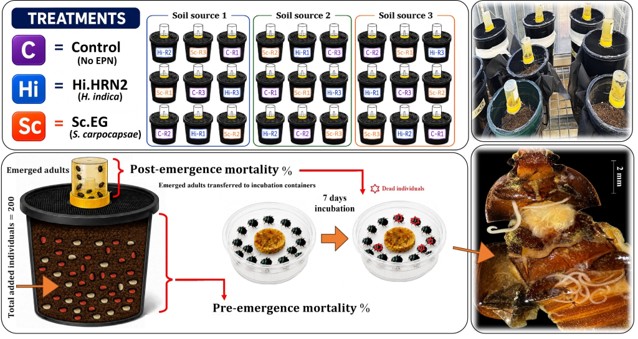
Figure 3. Semi-field design for evaluating EPN treatment of the soil-dwelling stage of small hive beetle. Control pots and pots treated with H. indica Hi.HRN2 or S. carpocapsae Sc.EG were distributed across three soil sources. Two hundred wandering larvae were introduced per pot. The design measured mortality before adult emergence, followed surviving adults for seven days to quantify delayed post-emergence mortality, and confirmed nematode infection by dissection. Source: Katlav et al. (2026), manuscript under revision in Austral Entomology.
What the semi-field experiment showed
Both EPN treatments produced a strong and consistent reduction in small hive beetle survival. Pre-emergence mortality exceeded 60% for each EPN treatment, compared with approximately 12% in untreated soil. Among adults that emerged, a further approximately 37-40% died during the following seven days, whereas post-emergence mortality in the control was only a few per cent. When both phases were combined, total mortality was approximately 77-78% under Hi.HRN2 and Sc.EG, compared with about 15% in the control (Figure 4).
The delayed post-emergence effect is particularly important. A study that counted only beetles failing to emerge would substantially underestimate the biological-control impact. The findings show that EPN exposure can continue to affect beetles after they leave the soil, and therefore support the use of total mortality as a more realistic measure of treatment performance. Treatment effects were evident across all three soil sources despite natural differences in soil properties. This strengthens confidence that the mortality pattern was driven primarily by EPN treatment rather than by one unusual substrate. The two EPN species produced comparable overall suppression, creating flexibility for future work on formulation, persistence, environmental tolerance and application timing.
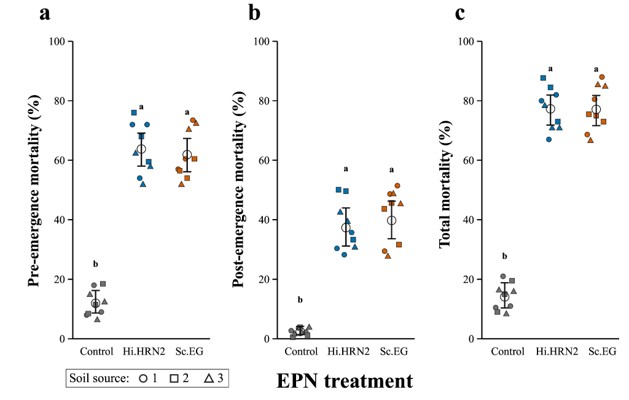
Figure 4. Effects of soil treatment on small hive beetle mortality. (a) Pre-emergence mortality was greater than 60% under both EPN treatments. (b) A substantial proportion of beetles emerging from treated soil died during the subsequent seven-day observation period. (c) Combined mortality approached 80% for both H. indica Hi.HRN2 and S. carpocapsae Sc.EG, compared with approximately 15% in the untreated control. Symbols identify the three soil sources; different letters indicate significant treatment differences. Source: Katlav et al. (2026), manuscript under revision in Austral Entomology.
|
Conclusion from the unpublished study (revised manuscript currently under review/editorial decision) The soil phase of the small hive beetle life cycle is a high-value intervention point: it concentrates the pest in a treatable environment while creating physical separation from honey bee brood, adult workers and hive products. |
Stage 3: Explaining host susceptibility through comparative transcriptome (RNA-seq) analyses of immune responses
Our previous studies demonstrated clear differences in susceptibility to EPN infection among host species. Small hive beetle larvae were consistently less susceptible and experienced slower mortality than greater and lesser wax moth larvae, although selected EPN isolates still provided effective control of the soil-dwelling stages of this pest (Aryal et al., 2025; Katlav et al., 2025). Direct-exposure experiments also established that honey bee larvae can be susceptible to EPN infection (Katlav et al., 2026). Stage 3 therefore uses comparative RNA sequencing to investigate the immune and physiological mechanisms underlying the contrasting susceptibility of small hive beetle, greater wax moth and honey bee larvae. The final phase asks why the outcomes differ among hosts. RNA sequencing measures changes in gene activity across thousands of genes and can reveal how insects recognise infection, activate defence pathways, respond to tissue damage and manage physiological stress. The study will compare small hive beetle larvae as the principal target pest, greater wax moth larvae as a highly susceptible comparative host, and honey bee larvae as the essential non-target host.
During development and pilot testing, the experimental design was refined to two carefully selected pest hosts plus honey bee. This was a strengthening decision, not a reduction in ambition. Concentrating the sequencing allocation increased total sample size and biological replication, preserved two informative sampling times and avoided a broad but underpowered experiment. Varroa was not included because its biology and sample requirements are not directly comparable with larval insect hosts, while lesser wax moth overlapped functionally with greater wax moth and would have diluted replication across the entire design.
Several pilot experiments were used to optimise dose and timing by monitoring survival, infection progression and visible physiological changes. Samples collected too early might show little detectable response, while samples collected too late could reflect terminal infection, mortality or tissue degradation. The selected 12-hour time point was designed to capture early immune recognition, wound signalling, melanisation and initial antimicrobial and stress responses. The 18-hour time point is designed to capture a more established response to the nematodes and their symbiotic bacteria while larvae remain alive and biologically informative.
The final design contains 66 RNA-seq libraries (AUD $410 per library; total sequencing cost of AUD $27,060) across three hosts, untreated controls and two EPN treatments representing two distinct species: H. indica HRN2B and S. carpocapsae Sc.EG. EPN-treated groups have four biological replicates per time point and controls have three. The sequencing quote and institutional approval have been finalised, and sample preparation, quality assessment, library preparation and bioinformatics are underway (Figure 5).
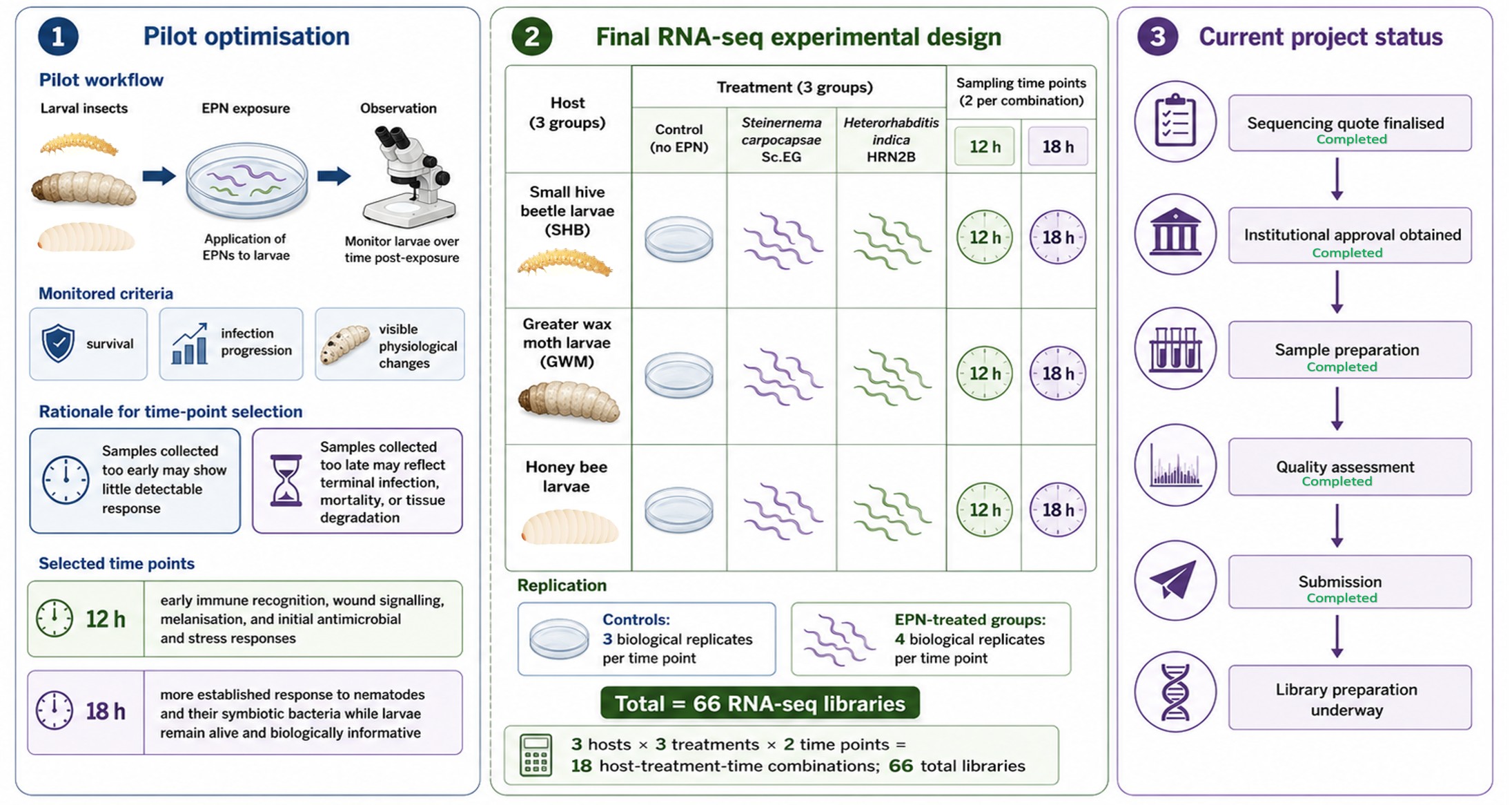
Figure 5. Comparative RNA-seq experimental design for investigating host-specific responses to entomopathogenic nematode (EPN) infection. Pilot experiments were used to optimise EPN dose and sampling time by monitoring larval survival, infection progression and visible physiological changes. Small hive beetle, greater wax moth and honey bee larvae are exposed to Steinernema carpocapsae Sc.EG, Heterorhabditis indica HRN2B or an untreated control and sampled at 12 and 18 hours post-inoculation. EPN-treated groups include four biological replicates per time point, whereas control groups include three, giving a total of 66 RNA-seq libraries. The selected time points are intended to capture early immune recognition and stress responses at 12 hours and more established host responses to nematodes and their symbiotic bacteria at 18 hours while larvae remain alive and biologically informative.
The allocation prioritises stronger replication in the EPN-treated groups, where the principal differential gene-expression comparisons will be made, while retaining appropriate controls and remaining within the available sequencing budget. Following sequencing and bioinformatic analysis, the study will compare immune-recognition pathways, Toll and IMD signalling, melanisation, antimicrobial defence, oxidative stress, detoxification, cellular immunity, apoptosis and tissue-damage responses. It will provide the mechanistic basis needed to interpret the susceptibility and mortality patterns observed in the earlier phases of the project.
Major achievements and significance
- A comprehensive honey bee safety assessment tested 32 Australian EPN isolates representing five species across larvae, pupae and adult workers.
- A peer-reviewed open-access article established that direct exposure can create non-target risks and defined the precautions required for in-hive and above-ground applications.
- A semi-field experiment demonstrated strong suppression of the soil-dwelling stage of small hive beetle, including substantial delayed mortality after emergence.
- A second manuscript is under revision in Austral Entomology, translating the safety findings into a targeted pest-management pathway.
- A strategically strengthened 66-library transcriptomic experiment has increased sample size and replication while preserving two pilot-optimised sampling times.
- The project has established an integrated framework in which EPN strain, host identity, pest life stage, application location and honey bee safety are evaluated together.
- The combined programme provides a strong foundation for a third high-impact publication in molecular ecology, insect immunity or host-pathogen biology.
Research dissemination and professional communication
The research has already been disseminated through peer-reviewed publication, manuscript preparation, professional presentations and specialist discussion. Dr Alihan Katlav presented “The enemy of my enemy is not always my friend: Susceptibility of honey bee to entomopathogenic nematodes” at the 2025 Entomology Conference of the Australian Entomological Society in Canberra. The programme was also represented through the team presentation “Survival of Australian entomopathogenic nematodes in different substrates and their post-storage virulence against small hive beetle, Aethina tumida.” The RNA-seq findings will be incorporated into future conference presentations, research seminars and discussions with bee-health, insect-pathology and biological-control researchers.
How Eva Crane Trust support made the difference
Eva Crane Trust funding was decisive because it connected research stages that would otherwise have remained separate. It enabled the programme to progress from broad susceptibility screening to applied small hive beetle control and then to a mechanistic comparison of host immune responses. The support made it possible to ask not only whether EPNs work, but how they work, which hosts they affect, where they can be deployed most safely and why different hosts show contrasting outcomes.
The research grant has also increased the reach and durability of the work. It contributed to a peer-reviewed open-access publication, supported a second applied manuscript, enabled the approved 66-library transcriptomic design and strengthened collaboration across honey bee health, insect pathology, molecular biology and biological control. The resulting datasets, figures and manuscripts will remain useful well beyond the formal grant period and provide a platform for future funding, field validation and technology development.
What happens next?
The immediate next step is to complete sample submission, library preparation and sequencing, followed by raw-read quality assessment, trimming and filtering, host-specific transcript mapping or quantification, differential gene-expression analysis and functional annotation. Responses to each EPN will be compared with untreated controls within each host and then interpreted across hosts and time points. The analysis will identify conserved and host-specific responses and determine whether molecular signatures help explain the strong susceptibility of some hosts and the relative tolerance of others.
The transcriptomic results will be used to prepare a third manuscript. Subsequent research will refine soil application rates, formulation, persistence and timing; assess performance under a wider range of field conditions; and determine how EPNs can be integrated with other small hive beetle management practices. The longer-term objective is a treatment strategy that places the right nematode against the right pest stage while avoiding unnecessary exposure of honey bees.
Conclusion
This project began aimed to unravel molecular immune responses caused by natural enemies in honey bee pests and developed into a broader demonstration of responsible biological control. The work shows that EPNs have genuine potential against honey bee pests, particularly when the vulnerable soil-dwelling stage of small hive beetle is targeted. It also establishes that natural enemies cannot be assumed to be safe under every exposure scenario. Direct contact with honey bee brood or workers can create risk, and application context is therefore as important as virulence.
The Eva Crane Trust grant has transformed the research from descriptive susceptibility testing into a comprehensive research program output with one published article, one manuscript under revision, a formally approved 66-library RNA-seq experiment and a strong foundation for a third major publication. By linking target-pest control, non-target safety and molecular mechanism, the project provides a substantially stronger scientific basis for the safe, targeted and evidence-based use of entomopathogenic nematodes in bee-health systems.
Acknowledgement
This research was supported by the Eva Crane Trust under grant number ECT_20240932A. The project was conducted at the Hawkesbury Institute for the Environment, Western Sydney University, by Dr Alihan Katlav, Dr Sitaram Aryal, Dr Jennifer Morrow and Professor Markus Riegler, with contributions from the wider honey bee and EPN research programme. The research team gratefully acknowledges the EVA CRANE TRUST for their generous funding and enabling the progression from laboratory screening to applied pest management and advanced molecular investigation.
Dr Alihan Katlav
Hawkesbury Institute for the Environment
Western Sydney University
Ref.: ECT_20240932A
Completed 2026
References
Aryal, S., Katlav, A., House, C. M., Spooner-Hart, R. N., Duncan, M., Nielsen, U. N., Cook, J. M., & Riegler, M. (2025). Virulence and biocontrol potential of entomopathogenic nematodes against soil-dwelling stages of the small hive beetle under laboratory and semi-field conditions. Pest Management Science, 81(7), 4004–4015.
Cuthbertson, A. G. S., Mathers, J. J., Blackburn, L. F., Powell, M. E., Marris, G., Pietravalle, S., Brown, M. A., & Budge, G. E. (2012). Screening commercially available entomopathogenic biocontrol agents for the control of Aethina tumida (Coleoptera: Nitidulidae) in the UK. Insects, 3(3), 719–726.
Dillman, A. R., & Sternberg, P. W. (2012). Entomopathogenic nematodes. Current Biology, 22(11), R430–R431.
Ellis, J. D., Spiewok, S., Delaplane, K. S., Buchholz, S., Neumann, P., & Tedders, W. L. (2010). Susceptibility of Aethina tumida (Coleoptera: Nitidulidae) larvae and pupae to entomopathogenic nematodes. Journal of Economic Entomology, 103(1), 1–9.
Evans, J. D., Aronstein, K., Chen, Y. P., Hetru, C., Imler, J.-L., Jiang, H., Kanost, M., Thompson, G. J., Zou, Z., & Hultmark, D. (2006). Immune pathways and defence mechanisms in honey bees Apis mellifera. Insect Molecular Biology, 15(5), 645–656.
Katlav, A., Aryal, S., Maanju, S., Duncan, M., House, C. M., Nielsen, U. N., Spooner-Hart, R. N., Cook, J. M., & Riegler, M. (2025). Entomopathogenic nematode performance in three honey bee pests: Small hive beetle, greater and lesser wax moths. Apidologie, 56(6), Article 97.
Katlav, A., Aryal, S., Dhakal, M., Duncan, M., House, C. M., Nielsen, U. N., Cook, J. M., Spooner-Hart, R. N., & Riegler, M. (2026). The enemy of my enemy is not always my friend: Susceptibility of honey bee to entomopathogenic nematodes. Journal of Invertebrate Pathology, 215, 108524.
Katlav, A., et al. (2026). Efficacy of Australian entomopathogenic nematodes against the pupal stage of small hive beetle (Aethina tumida) under semi-field conditions. (under revision for Austral Entomology)
Kwadha, C. A., Ong’amo, G. O., Ndegwa, P. N., Raina, S. K., & Fombong, A. T. (2017). The biology and control of the greater wax moth, Galleria mellonella. Insects, 8(2), 61.
Rosenkranz, P., Aumeier, P., & Ziegelmann, B. (2010). Biology and control of Varroa destructor. Journal of Invertebrate Pathology, 103(Suppl. 1), S96–S119.
Roth, M. A., Wilson, J. M., & Gross, A. D. (2022). Biology and management of small hive beetles (Coleoptera: Nitidulidae): A pest of European honey bee (Hymenoptera: Apidae) colonies. Journal of Integrated Pest Management, 13(1), 7.
Shapiro-Ilan, D. I., Hazir, S., & Glazer, I. (2017). Basic and applied research: Entomopathogenic nematodes. In L. A. Lacey (Ed.), Microbial control of insect and mite pests: From theory to practice (pp. 91–105). Academic Press.
Tarasco, E., Fanelli, E., Salvemini, C., El-Khoury, Y., Troccoli, A., Vovlas, A., & De Luca, F. (2023). Entomopathogenic nematodes and their symbiotic bacteria: From genes to field uses. Frontiers in Insect Science, 3, 1195254.
Zhao, X., & Liu, Y. (2022). Current knowledge on bee innate immunity based on genomics and transcriptomics. International Journal of Molecular Sciences, 23(22), 14278.