

Why this project?
For many years the parasitic mite Varroa destructor has been ravaging Western honeybee colonies. Over the last 40 years or so, honeybees have not been able to adequately adapt to Varroa presence and in the wild colonies have disappeared. Propagating the autonomous hygiene behavior of honeybees to make colonies more resistant against Varroa have not yet resulted in the desired outcome and in general Varroa needs to be controlled chemically, still.
Interestingly, also the basics of beekeeping itself did not change much in this 40 odd-year period and many beekeepers still re-use and recycle wax in their beekeeping practices. As wax is a perfect matrix for incorporating all kinds of contaminants and (volatile) organic compounds, it is a notorious archive of pollutants that increases every cycle it is used. Aged and ‘dirty’ wax can greatly impact the interior atmosphere of the beehive by releasing previously accumulated odors. By doing so, the olfactory cues of Varroa infestation might be lost to honeybees resulting in failing hygienic behavior and low Varroa removal.
Aims and objectives
In this project, we tested the Varroa removal efficiency of honeybee colonies housed on old combs and colonies housed on freshly build combs. It was expected that without interfering olfactory cues from aged wax, honeybees will detect Varroa infestation more easily and their hygienic behavior is more efficient resulting in a higher mite drop and lower total mite counts.
Methodology
We installed hives in three different apiaries: two in The Netherlands (Wageningen and Den Ilp) and one in Denmark (Stenlille). In order to test the impact of ‘smelly’ combs on Varroa infestation, bees were kept on either old used ‘smelly combs’ or were housed on freshly wild-build combs. Wild-build combs were manufactured by the bees themselves by offering them an empty frame containing a small wax strip on the top. In Wageningen and Den Ilp, the apiary-reared egg laying new queens were housed in new, not-painted wooden hives. For the treatment containing fresh combs, the young queens started on old combs which were replaced by the empty frames as soon as the brood of the old comb had emerged. In Denmark rearing queens by the beekeeper is not common practice so in order to populate the test, sealed queen cells ready to hatch within 24 hours, were purchased from a nearby Buckfast breeder. The cells were introduced into nukes where they successfully hatched.
From the beginning of June 2025 in Den Ilp (NL) and Stenlille (DK), and from beginning July 2025 in Wageningen (NL), the natural mite drop was recorded weekly and recalculated to ‘mite drop per day’. The study was terminated in October with a formic acid (60%) treatment with the Nassenheider formic acid vaporizer. After the start of the formic acid treatment the mite drop was monitored for another three weeks.
To follow the colony development during the test period the bees and capped brood cells were photographed regularly until the formic acid treatment. In Wageningen and Den Ilp the colonies were assessed five times, in Stenlille three times. The number of bees and capped brood was calculated according to the method described in Coloss Beebook nr. I.
Furthermore it should be noted that in Wageningen (NL) and Stenlille (DK) the hives were positioned in a row out in the open, whilst in Den Ilp (NL) the hives were positioned into a sheltered apiary.
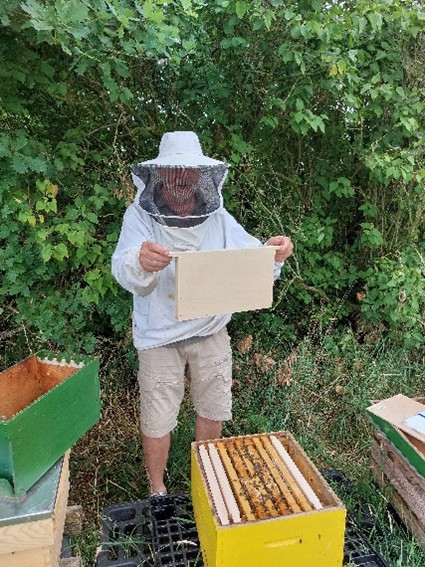 Fig. 1: setting up the colonies. Note that free space in the hive was filled up using closing blocks to avoid temperature stress in the developing colony.
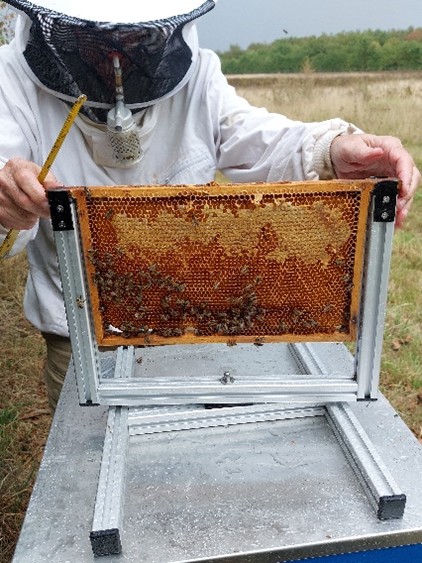 Fig. 2: Photographing bees and capped brood using custom build frame holding device.
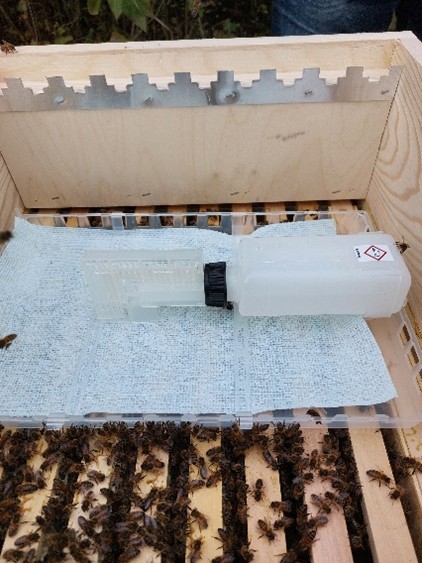 Fig. 3: Impression of the Varroa treatment using Nassenheider formic acid vaporizer.
Outcomes
During the test period we lost one colony on old combs in Wageningen (NL), one colony on wild-build combs in Den Ilp (NL), and both one colony on old combs and wild-build combs in Stenlille (DK). The natural mite drop increased inversely with the decreasing number of capped brood, starting end July, beginning of August. After a peak in September the natural mite drop decreased, indicating the phoretic mite population had stabilised on the now present winter bees.
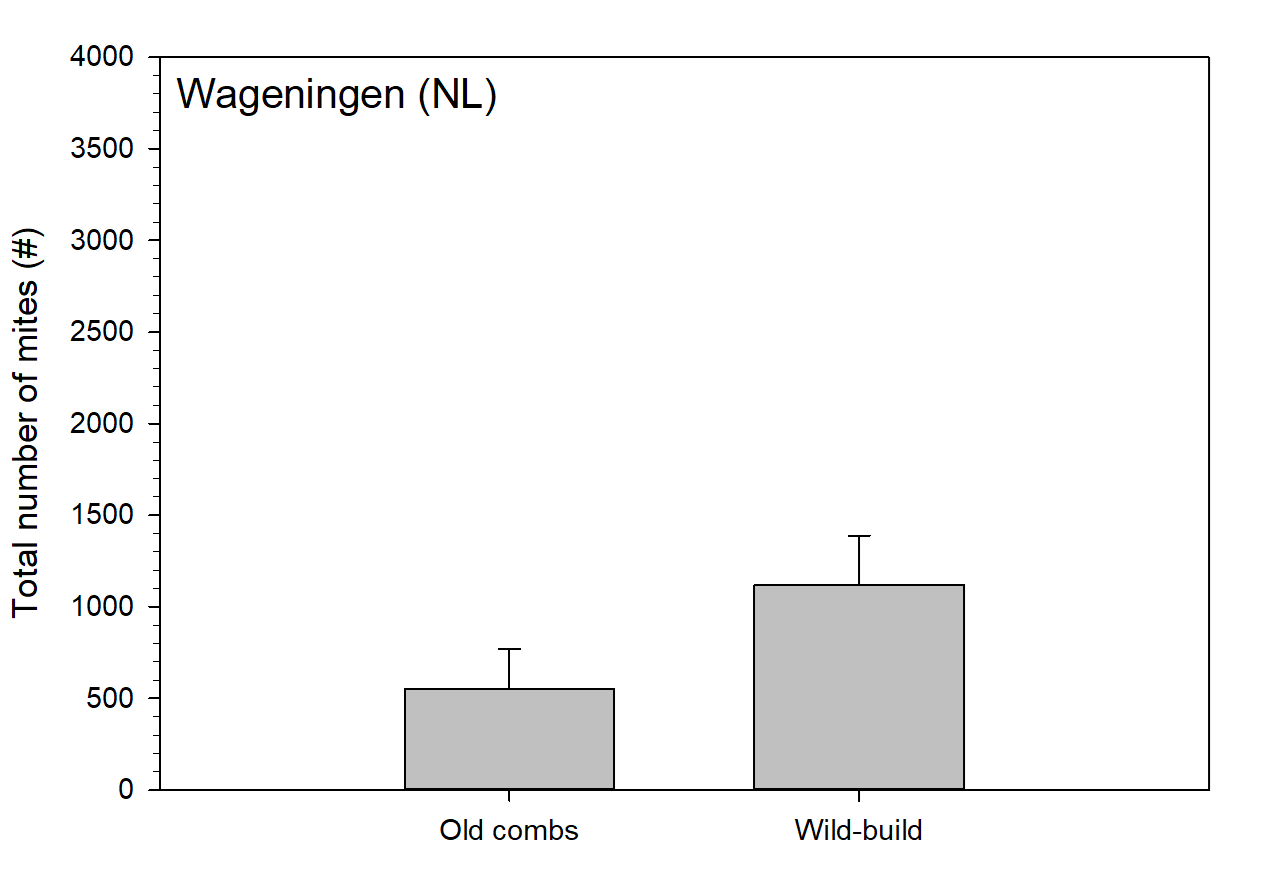
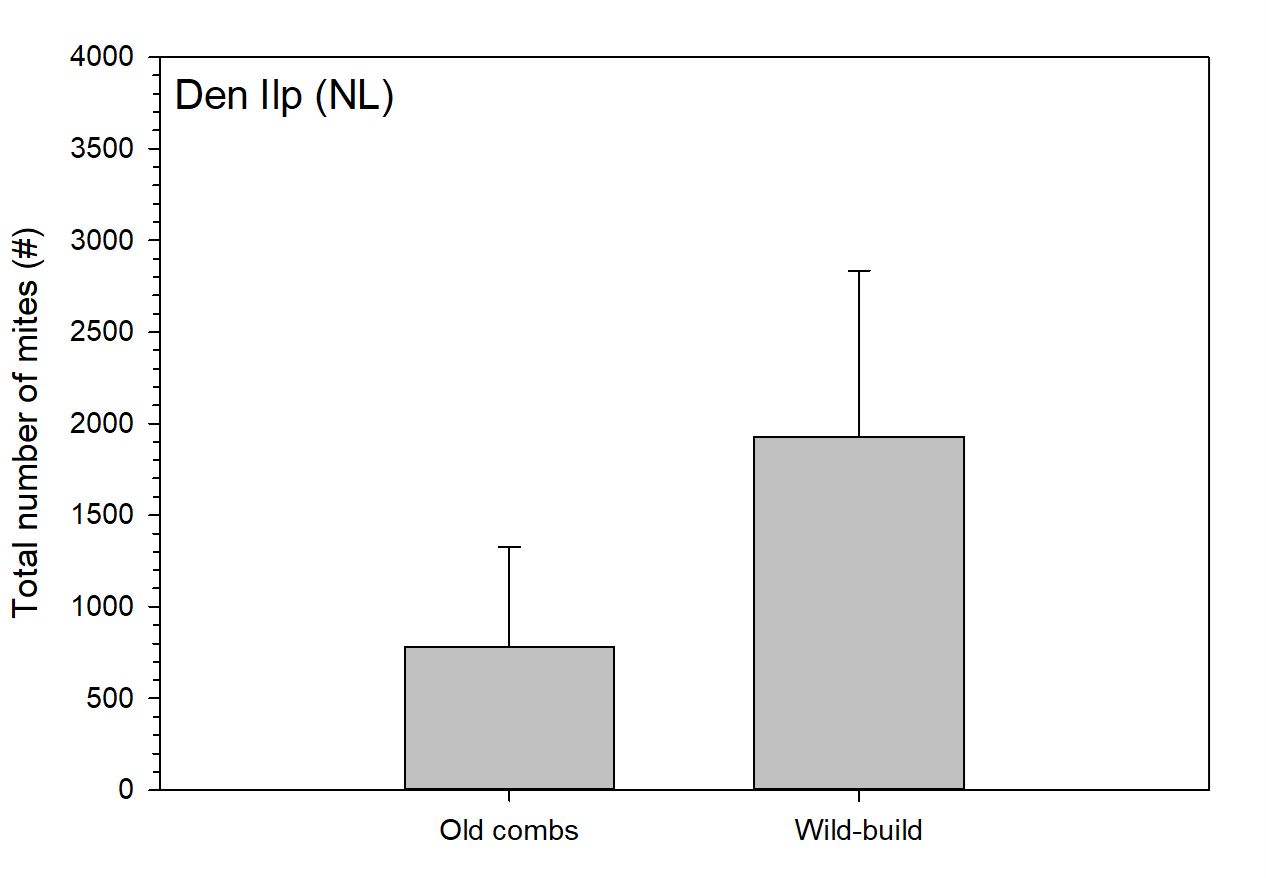
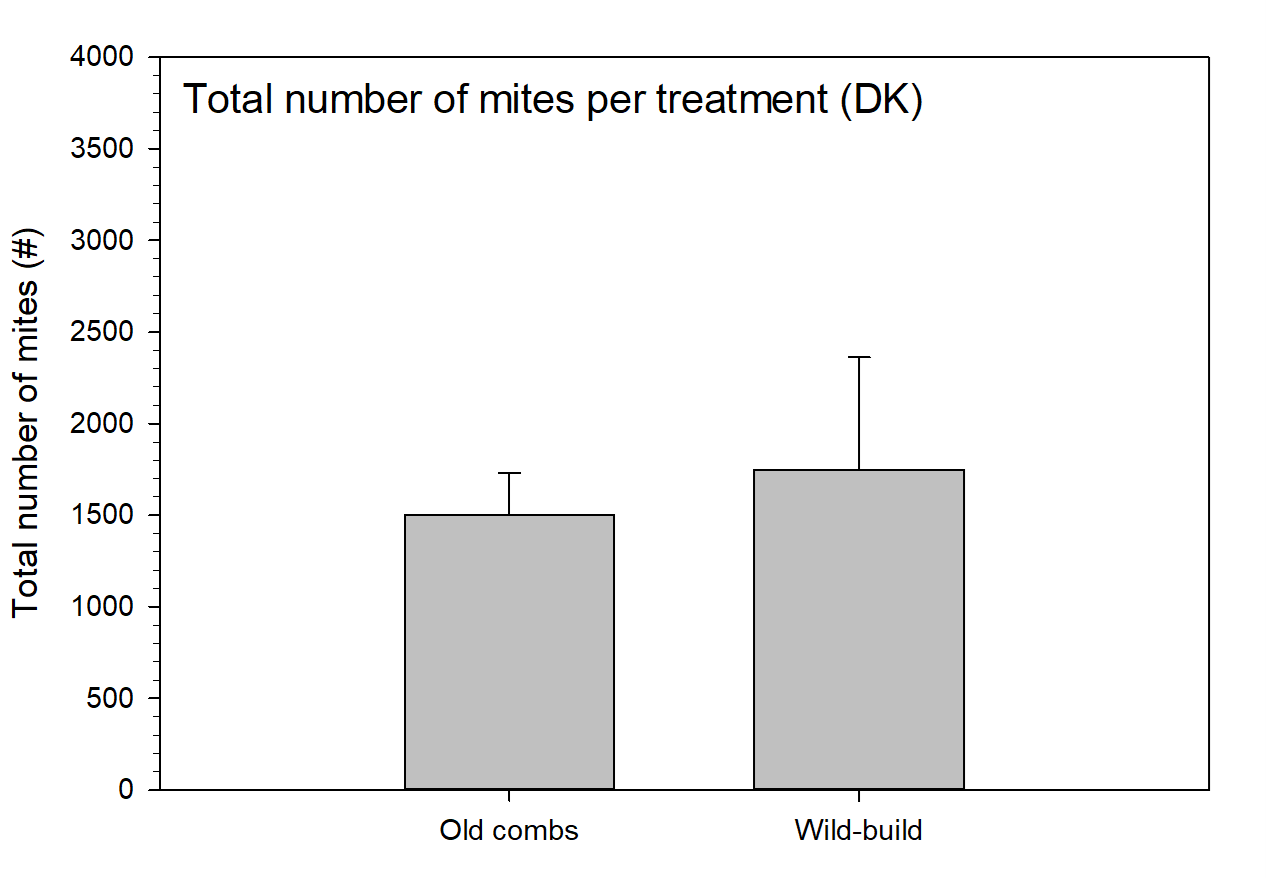
Fig. 4. Overview of the total amount of mites present during the experimental season in all hives,
excluding the hives at corner positions in Wageningen (NL) and Stenlille (DK).
The formic acid treatment shows a peak of around 140 mites per day, both in the wild-build combs and old combs colonies. Interestingly, there was no clear statistical difference between the results of colonies with old combs and wild-build fresh combs. As bees are known to favour returning to hives at corner positions in an apiary, these hives might bias the overall results. When discarding the hives at corner positions, it looks that less Varroa is found at the hives equipped with old-combs. Again, it should be noted that these differences are not statistically significant.
Furthermore it should be noted that during winter all colonies in Denmark died, whereas in the Netherlands most colonies survived.
Conclusions
These data show that the original hypothesis must be rejected; colonies on newly self-built combs do not have less varroa mites.
In addition, the pattern of natural mite drop confirms earlier observations that a varroa treatment should start before the decrease of the capped brood, to prevent the huge influx of mites in the remaining cells during the decrease of capped brood process.
ECT funding
This work would not have been possible without ECT funding. The team has relied entirely on funds provided by the ECT.
Dr. Ivo Roessink
Wageningen Environmental Research
Ref.: ECT_2025030422A
Completed 2026