

Banner image: Dr. Yahya Al Naggar - Microscopic view of Nosema ceranae spores
Introduction
Honey bees play a vital role in agriculture and natural ecosystems through pollination. Many crops depend on bees to produce fruits, vegetables, nuts, and seeds. However, honey bee colonies face numerous threats, including parasites, pathogens, pesticides, poor nutrition, and environmental stress. One of the most widespread diseases affecting honey bees worldwide is caused by Nosema ceranae, a microscopic fungal parasite that infects the digestive tract of adult bees. Infected bees often suffer from reduced lifespan, weakened immunity, lower productivity, and, in severe cases, colony decline. Traditional disease management options for Nosema are limited. Some chemical treatments have shown variable effectiveness, while concerns remain about resistance development and long-term sustainability. Consequently, researchers are increasingly searching for alternative methods to improve honey bee health naturally. Our project investigated an exciting possibility: can honey bees be “trained” to defend themselves against Nosema before infection occurs?
Why Was This Project Necessary?
Unlike humans and other vertebrates, insects do not possess an adaptive immune system capable of producing antibodies. For many years, scientists believed insects could not develop any form of immune memory. Recent research has challenged this assumption. Studies suggest that insects may possess a phenomenon known as immune priming. In simple terms, previous exposure to harmless pathogen material can prepare the immune system to respond more effectively when a real infection occurs later. This concept resembles vaccination in principle, although the biological mechanisms differ from those found in humans.
Evidence for immune priming in honey bees remains limited. Important questions remain unanswered:
• Can immune priming reduce Nosema infections?
• Does it improve survival?
• What happens inside the bee immune system after priming?
• Could immune priming eventually be used as a practical disease-management tool?
The Eva Crane Trust supported our efforts to answer these questions.
Aims and Objectives
The primary aim of this project was to determine whether immune priming could enhance honey bee resistance to Nosema ceranae infection.
Specific objectives included:
• Measuring survival of primed and non-primed bees.
• Quantifying Nosema infection intensity.
• Assessing cellular immune responses through hemocyte counts.
• Measuring expression of important immune-related genes.
• Determining whether different priming doses influence protection.
Methodology
The study was conducted using newly emerged worker honey bees collected from healthy colonies.
We first isolated Nosema spores from naturally infected honey bees. Some spores were kept alive for later infection challenges, while others were heat-treated to render them harmless.
The harmless heat-killed spores were used for immune priming.
Honey bees were divided into five experimental groups:
- Healthy control bees (0_0).
- Bees infected with a low dose of live Nosema spores (0_40).
- Bees infected with a high dose of live Nosema spores (0_100).
- Bees primed with heat-killed spores and later challenged with a low dose of live spores (IP_40.
- Bees primed with heat-killed spores and later challenged with a high dose of live spores (IP_100).
The bees were maintained under carefully controlled laboratory conditions. Survival was monitored daily. Researchers also measured infection levels, immune cell numbers, and activity of several important immune genes.
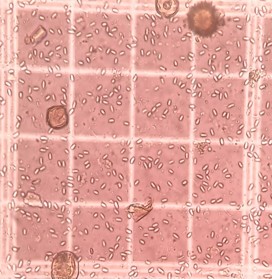
Figure 1 (a). Microscopic view of Nosema ceranae spores observed using a hemocytometer during parasite quantification. Researchers counted these spores to determine infection levels in honey bees and evaluate the effectiveness of immune priming treatments.
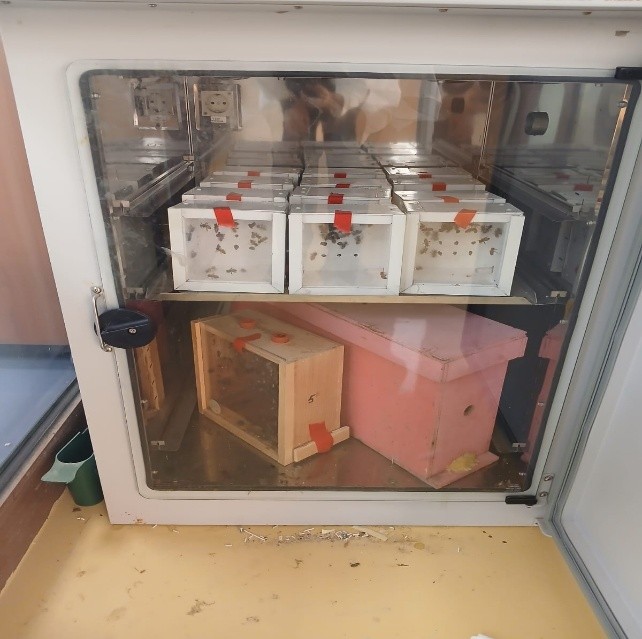
Figure 1 (b) Experimental setup showing honey bees housed in laboratory cages inside a temperature-controlled incubator. This system was used to investigate the effects of immune priming on bee survival, infection intensity, and immune responses following Nosema exposure.
Outcomes
The results were highly encouraging.
Improved Survival
Bees exposed to Nosema without immune priming experienced substantially higher mortality. In contrast, primed bees survived significantly longer and showed survival rates similar to healthy controls.
Reduced Infection
Immune-primed bees carried significantly fewer Nosema spores than non-primed bees. This indicates that immune priming successfully limited parasite proliferation inside the bee gut.
Stronger Immune Responses
Primed bees maintained higher numbers of circulating immune cells known as hemocytes. These cells play important roles in recognizing and combating infections.
Enhanced Gene Expression
The project also revealed major differences in immune gene activity.
Non-primed infected bees showed suppression of several important immune genes. In contrast, primed bees displayed strong activation of genes involved in antimicrobial defense and immune regulation.
These findings suggest that immune priming prepares the honey bee immune system for a more effective response when infection occurs.
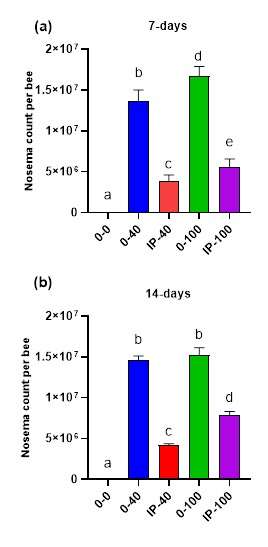
Figure 2. Immune priming reduced Nosema infection in honey bees. Bees that were first exposed to harmless Nosema spores carried fewer parasites than bees that were infected without prior immune priming, both 7 and 14 days after infection. Different letters indicate significant differences between treatment groups. The primary treatment consisted of a control (no spores) or immune priming with heat-killed spores at either 4 × 10⁴ (IP-40) or 1 × 10⁵ (IP-100). A secondary treatment followed this in sugar solution, consisting of no spores (0–0) or exposure to freshly harvested spores at 4 × 10⁴ (0–40 or IP-40) or 1 × 10⁵ (0–100 or IP-100). Different lowercase letters indicate statistical differences between treatments (one-way analysis of variance (ANOVA) with Tukey’s post-hoc test, p < 0.05).
Unexpected Findings
One particularly interesting observation was that lower priming doses often performed as well as, or even better than, higher doses. This finding may be important for future applications because lower doses could be easier and more economical to implement in practical beekeeping settings.
Why These Findings Matter
The results provide strong evidence that immune priming can improve honey bee resistance to Nosema infection. This research contributes to a growing understanding of insect immune memory and demonstrates that honey bees can benefit from previous exposure to harmless pathogen material.
From a practical perspective, immune priming could eventually become part of sustainable disease-management strategies that reduce dependence on chemical treatments. Although further research is needed before field implementation, the concept offers exciting possibilities for supporting honey bee health worldwide.
How We Benefited from Eva Crane Trust Funding
The support provided by the Eva Crane Trust was essential for the success of this project. Funding enabled us to carry out all experimental work, purchase laboratory consumables, conduct molecular analyses, and complete comprehensive assessments of immune responses and infection levels. The grant allowed us to investigate a novel research question that otherwise would have been difficult to pursue at this scale. Importantly, the support generated findings that advance scientific understanding of honey bee immunity and provide a strong foundation for future research.
What Happens Next?
The project has now been completed, and the research team is currently preparing a manuscript for submission to a leading international peer-reviewed journal. Future studies will examine whether immune priming can provide long-term protection under real beekeeping conditions and whether similar approaches can be used against additional honey bee diseases.
Conclusion and Acknowledgment
Honey bees are indispensable pollinators whose health is increasingly threatened by emerging diseases and environmental stressors. Our study demonstrates that immune priming using harmless Nosema spores can significantly improve survival, reduce infection intensity, and strengthen immune responses in honey bees. These findings represent an important step toward the development of innovative, sustainable, and environmentally friendly approaches for improving honey bee health.
We gratefully acknowledge the Eva Crane Trust for making this research possible through its generous support.
Prof. Dr. Yahya Al Naggar
King Khalid University, Saudi Arabia
Ref.: ECT_202506466A
Completed 2026